
Every organization says collaboration matters.
So why are so many teams still trapped inside systems they can't clearly see?
For leaders, facilitators, and change agents who know that most organizational problems aren't caused by people. They're caused by the structures those people are working within.
You launch workshops. You create action plans. You hold retrospectives.
Yet the same bottlenecks keep appearing.
The same friction returns.
The same conversations happen over and over.
Because the team keeps trying to fix symptoms without understanding the system creating them.
When talented people are working hard, but the system works against them.
Most organizational improvement efforts focus on solutions.
But solutions don't help when you're solving the wrong problem.
What teams need first is a way to see the system clearly enough to understand what's actually driving their experience.
🔍
Teams keep discussing the same problems, but nobody can agree on where those problems actually originate.
🔍
Work slows down in predictable places, yet every fix seems temporary.
🔍
Informal workarounds have become more reliable than the official process.
🔍
🔍
Decisions happen far away from the people with the information needed to make them.
Leaders know collaboration could be better, but struggle to see the structural patterns creating friction.
Imagine what changes when people can see their system together.
Co-Lab gives organizations a practical way to investigate, understand, and improve collaboration by making the invisible structures of work visible.
✔️
Friction becomes visible before it becomes frustration.
✔️
Conversations move from blame toward discovery.
✔️
Leaders can identify structural constraints instead of treating every issue as a people problem.
✔️
✔️
Improvement efforts focus on the patterns that matter most.
Introducing
Co-Lab
A collaborative investigation toolkit that distills years of lean thinking into a practical system for organizational exploration. Instead of optimizing production lines, Co-Lab helps teams better understand the human systems through which work gets done.
PLACES stands for:
Co-Lab uses six integrated lenses:
See → Map → Find → Shift → Signal → Sustain
Together, these lenses help teams:
Reveal how their system actually operates.
Trace how work and information flow.
Locate sources of friction.
Design meaningful interventions.
Monitor organizational health.
Turn discoveries into lasting practice.
Unlike traditional frameworks, these lenses are not phases or steps. They are perspectives. Like the lenses used during an eye exam, each reveals something different, and deeper understanding comes from looking through all of them.
Teams develop a shared understanding of how work actually flows.
Exactly what you get:
Everything you need to surface emotional dynamics, make them discussable, and channel them into forward motion.
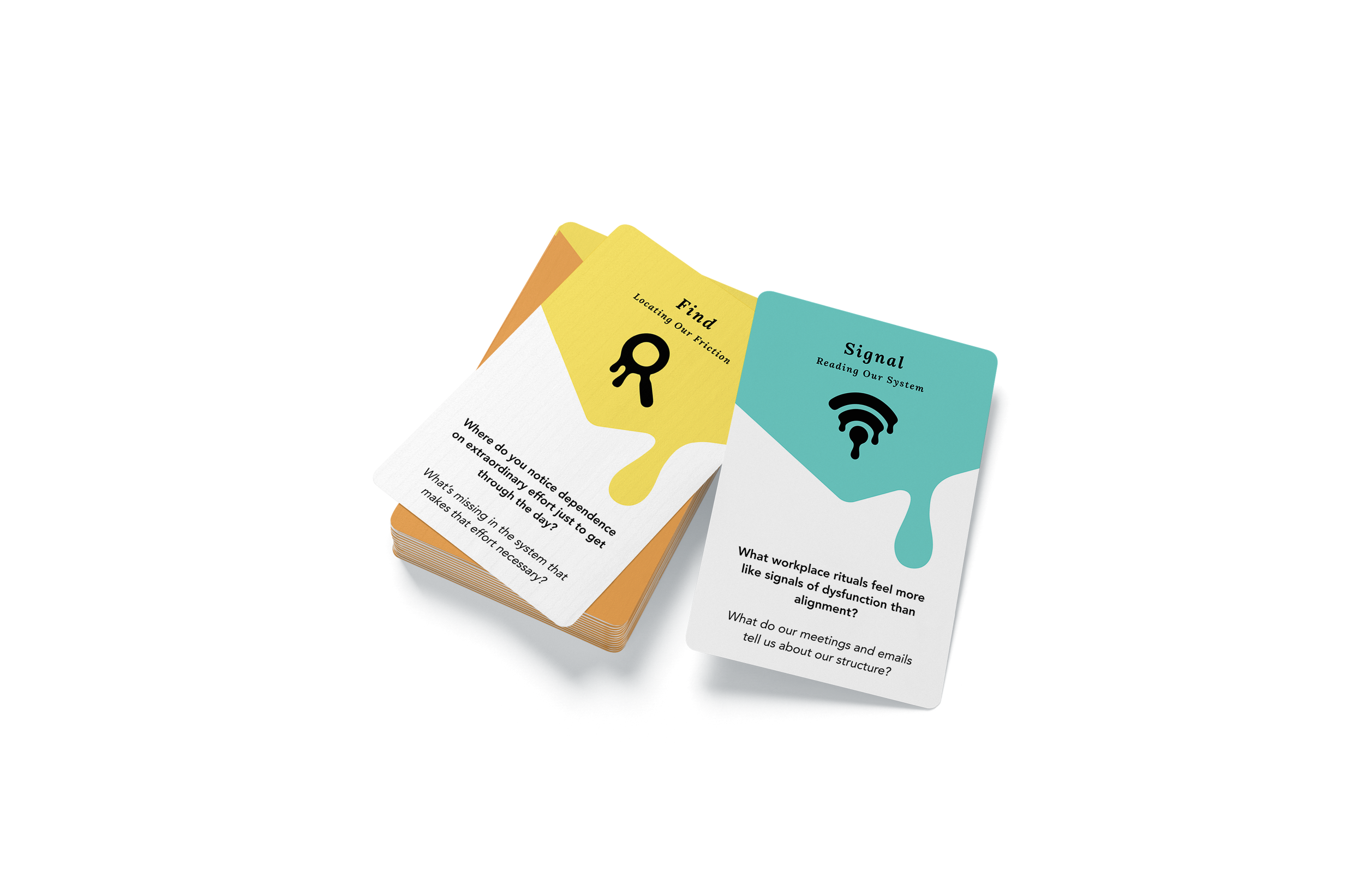
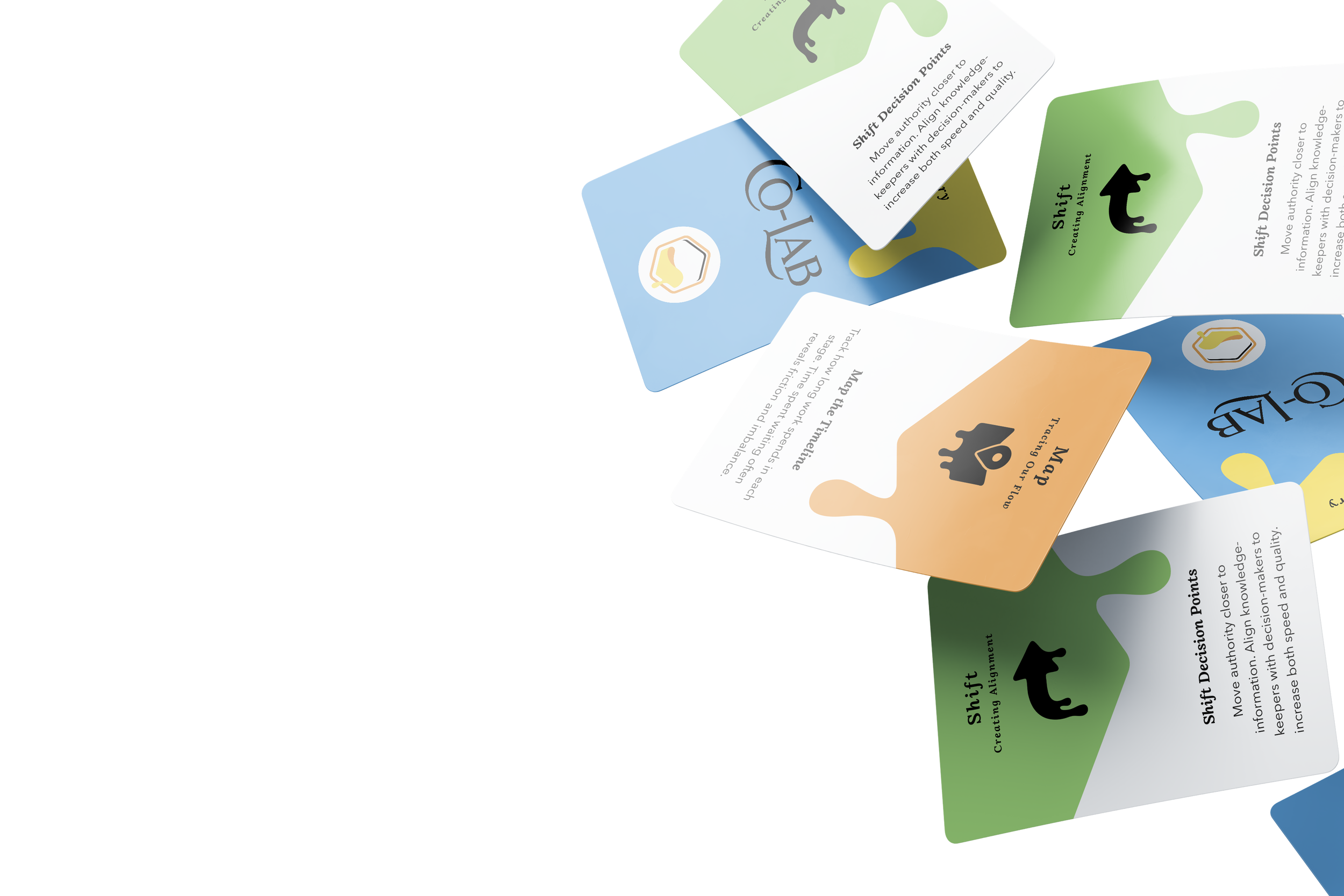
Discovery Deck
A collection of investigation tools organized around the six lenses. Each card helps groups observe patterns, identify constraints, and generate shared understanding about how their system functions.
Great for: retrospectives, organizational reviews, workshop facilitation, systems exploration.
Wayfinding Prompts
A practical set of facilitation prompts designed to help groups explore what they're seeing, deepen observations, and uncover meaningful insights together.
Great for: facilitators, team leads, organizational coaches, collaborative investigations.
Quick Start Guide
Everything you need to begin facilitating Co-Lab conversations quickly, without requiring extensive training.
Navigation Guide
Background information, facilitation guidance, and practical examples for applying the six lenses across different organizational contexts.
Great for: internal facilitators, change leaders, consultants, transformation teams.
Galaxy Guide
A visual overview of the complete Co-Lab ecosystem that helps participants understand how the six lenses work together.
Great for: orientation, workshop preparation, shared reference.
Logbook
A structured way to capture observations, patterns, discoveries, and next steps as participants develop a richer understanding of their systems.
Great for: reflection, documentation, improvement planning.
Sparks
Activities and provocations designed to help teams go deeper into specific organizational challenges and opportunities.
Great for: advanced facilitation, recurring team challenges, organizational learning.
Organizations usually know something isn't working. Co-Lab helps them discover why.
PLACES is especially powerful:
🎯
When the same organizational challenges keep returning.
👤
When leaders want to improve the system rather than manage around it.
🔀
When collaboration feels harder than it should.
🔄
When transformation efforts need deeper understanding before more action.
🌉
When teams are relying on workarounds instead of processes.
Whether you're working with a small team or a complex enterprise, Co-Lab scales because it focuses on helping people see their reality more clearly before deciding what needs to change.
What if organizational improvement started with observation instead of solutions?
Co-Lab was created by Leila Rao and the Cultural Cartography team by adapting proven concepts from lean thinking, systems observation, value stream analysis, constraint theory, intervention design, visual management, and continuous improvement into a framework for human collaboration.
Rather than prescribing a sequence to follow, Co-Lab equips practitioners with six complementary lenses they can use to understand the unique realities of their organization.
You might have some questions:
-
No. Co-Lab is not a prescribed sequence of steps. It is a collection of observation and intervention lenses that help organizations better understand collaboration and organizational systems.
-
No. The six lenses are equally important perspectives. Facilitators may emphasize different lenses at different times, but the lenses themselves do not contain an inherent hierarchy or sequence.
-
No. Co-Lab is designed to support exploration and discovery regardless of facilitation experience, while also providing depth for experienced practitioners.
-
Most workshop tools focus on activities. Co-Lab focuses on developing understanding. The six lenses help participants investigate structural patterns, flows, constraints, interventions, signals, and sustainability within their system.
-
Co-Lab can help organizations explore bottlenecks, decision-making challenges, collaboration friction, process breakdowns, recurring tensions, and system-wide improvement opportunities.
Ready to see your organization more clearly?
The organizations that improve fastest aren't the ones with the most solutions.
They're the ones that understand their systems deeply enough to choose the right solutions.
Co-Lab helps teams look through six different lenses, discover what has been hidden in plain sight, and build a clearer picture of how collaboration actually works.
Because meaningful change starts with seeing what was there all along.